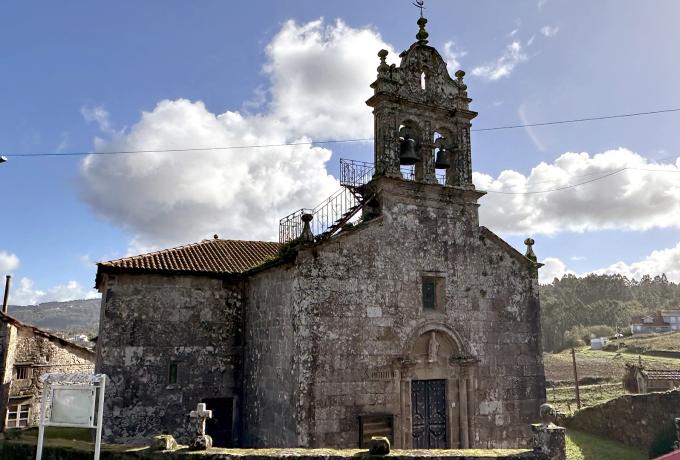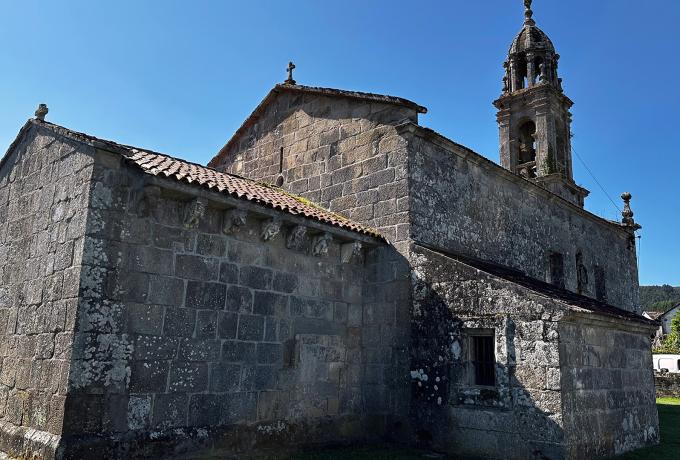


The Church of San Martiño de Ramil is one of the most distinctive temples in its surroundings due to the superposition of historical periods preserved in its structure. Clear pre-Romanesque and even Visigothic remains can be observed, originating from an earlier religious building that existed on the site before the major medieval reconstruction. These early remains were not completely removed but were incorporated into the new structure when the church was rebuilt in the early 12th century, allowing visitors today to perceive in its walls a continuity of centuries of religious history.
The Romanesque reconstruction of the 12th century largely replaced the earlier building, but it respected and integrated some of its oldest elements, which today constitute one of the main attractions of the monument. This coexistence of pre-Romanesque and Romanesque architecture makes San Martiño de Ramil an exceptional testimony to the architectural evolution of medieval Galicia, when earlier early-medieval temples were adapted to new architectural and liturgical forms.
Alongside these older remains, the interior of the temple also displays Gothic-influenced elements, particularly visible in its structural features, which add greater stylistic refinement and decorative richness. This dialogue between Visigothic, Romanesque and Gothicising forms reflects the long evolution of the building and turns it into a church of great interest for visitors, who can discover within a single space several key stages in the history of art and medieval Galician spirituality, set within a rural environment that still preserves the traditional character of the territory.