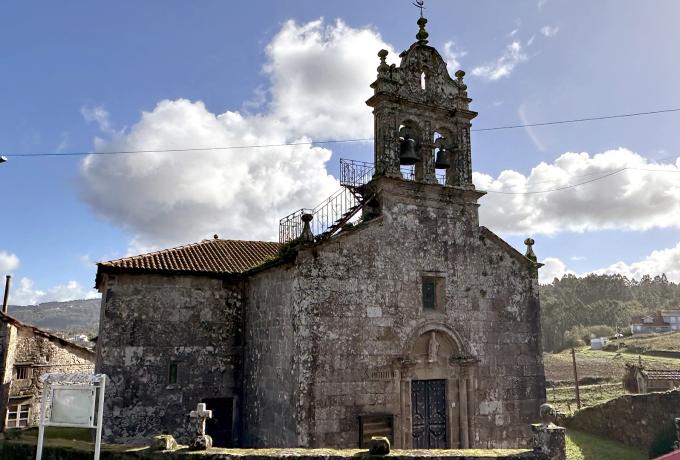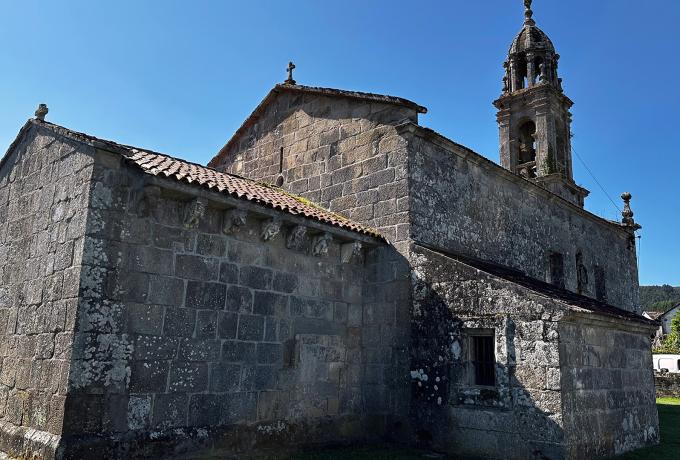


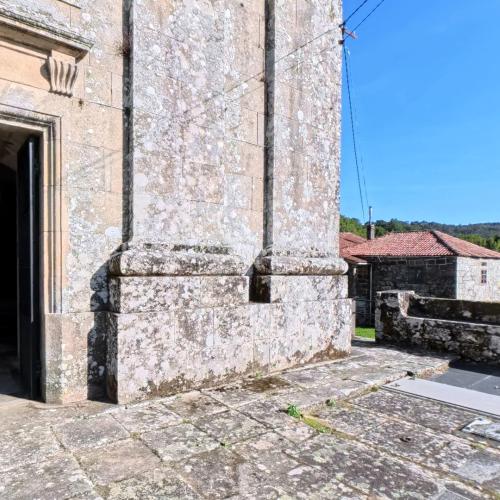
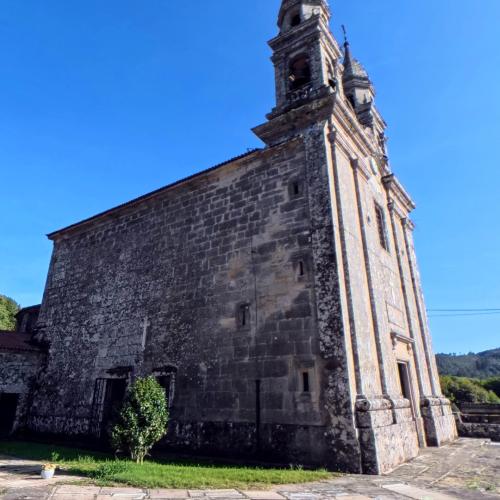

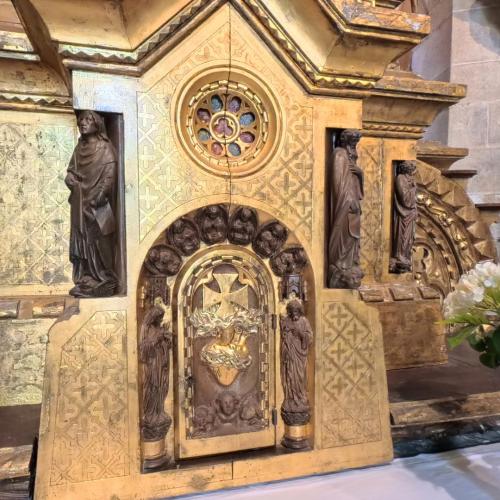
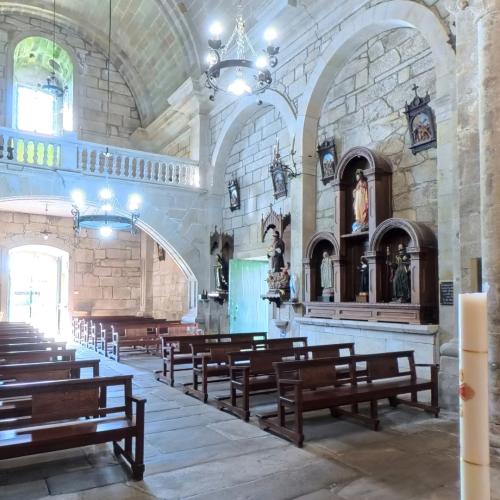
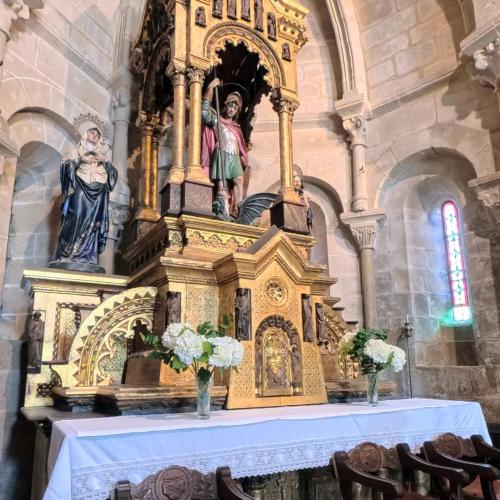
The Church of San Xurxo de Codeseda, located in the municipality of A Estrada, is one of the most distinctive Romanesque temples in the inland area of Pontevedra. Its origins date back to the 12th century, when King Alfonso VII, in 1124, granted Codeseda to Munio Pérez Tacón after both had been knighted in Compostela. A few years later, Munio Pérez himself donated the place and its church to a community of nuns linked to the see of Santiago, giving rise to the Monastery of San Xurxo de Augas Santas. In 1154, Pope Anastasius IV mentioned this monastic house in a papal bull as a possession of the Church of Compostela. The monastery survived until the 15th century, when, after only two nuns remained, it was suppressed by the chapter of Santiago. From that ancient monastery the Romanesque chancel has been preserved, considered one of the most beautiful and complete in the province of Pontevedra. Pentagonal in structure, the apse is connected to the nave by a straight section covered with a barrel vault, while the apse itself features a ribbed vault supported by engaged columns with decorated capitals displaying vegetal motifs of clear Compostelan influence. On the exterior, the apse is divided into five sections separated by attached semicylindrical columns that reinforce the angles, and it includes five windows ornamented with torus and chequered archivolts, whose carved tympana stand out for their delicacy and balance. The original Romanesque nave disappeared in 1851 and was later rebuilt. On the main façade, the date of one of its renovations, 1900, can be read, engraved above a clock and a scallop shell. Rising above the façade is a bell gable composed of two towers with two levels each, crowned by bell chambers with domes, completing the monumental silhouette of the complex. This contrast between the medieval sections and the later renovations makes it easy to understand the historical evolution of the building. Today, the Church of San Xurxo de Codeseda combines history, art and spirituality, preserving in its chancel the splendour of Galician Romanesque architecture linked to the Compostelan tradition and offering visitors a valuable testimony to the monastic past of A Estrada.
Location
Multimedia