

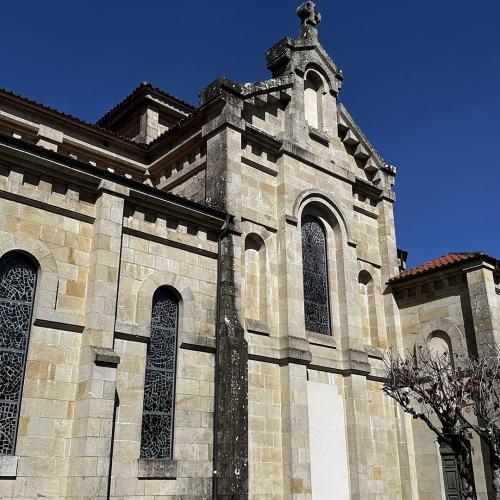
The municipality of A Estrada originated at a crossroads of medieval routes, a strategic point where roads coming from the south and the west converged on their way to Santiago de Compostela. This location benefited from the constant flow of pilgrims, merchants and travellers, which encouraged economic activity and the establishment of permanent settlements.
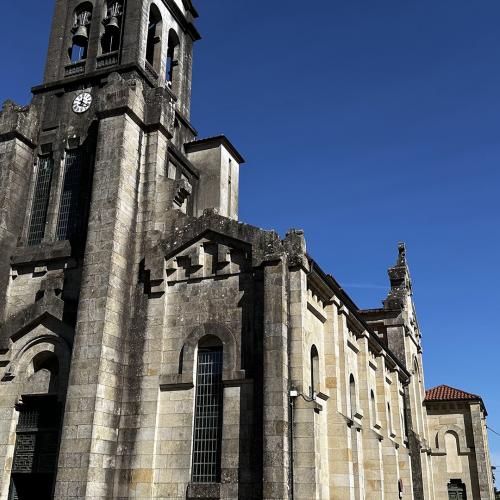
During the 19th century, A Estrada consolidated its importance as an administrative centre. Between 1839 and 1841, the Town Council was transferred to the town, raising its status to that of the central parish of the municipality. However, the locality still lacked a parish church, a need that soon became evident in order to serve both the inhabitants and the travellers passing through the area. This religious gap led the local authorities to request from the Archbishopric of Santiago de Compostela the construction of a temple dedicated to Saint Pelayo (San Paio), chosen as the patron saint by the community. The Parish Church of San Paio, designed and built following the request of 1856, symbolises the recognition of A Estrada as the administrative, social and spiritual centre of the municipality.
The main façade is one of the most representative elements of the building. It is arranged symmetrically, with a central body flanked by two bell towers, which reinforce its architectural presence and make it a visual landmark within the historic urban centre. The main entrance is structured through a semicircular arch, above which a classical and orderly composition is developed. Inside, the space stands out for its clarity and openness, favoured by the width of the nave and the height of the walls, which allow for effective natural lighting.
Beyond its religious function, the construction of the church reflects the urban growth and the consolidation of the town as a centre of transit, commerce and services in inland Galicia. Today, the Church of San Paio is one of the main heritage landmarks of the urban centre of A Estrada, reminding visitors and residents alike of the historical evolution of the town, from its origin as a crossroads of routes to its consolidation as an administrative and social centre of the territory.